
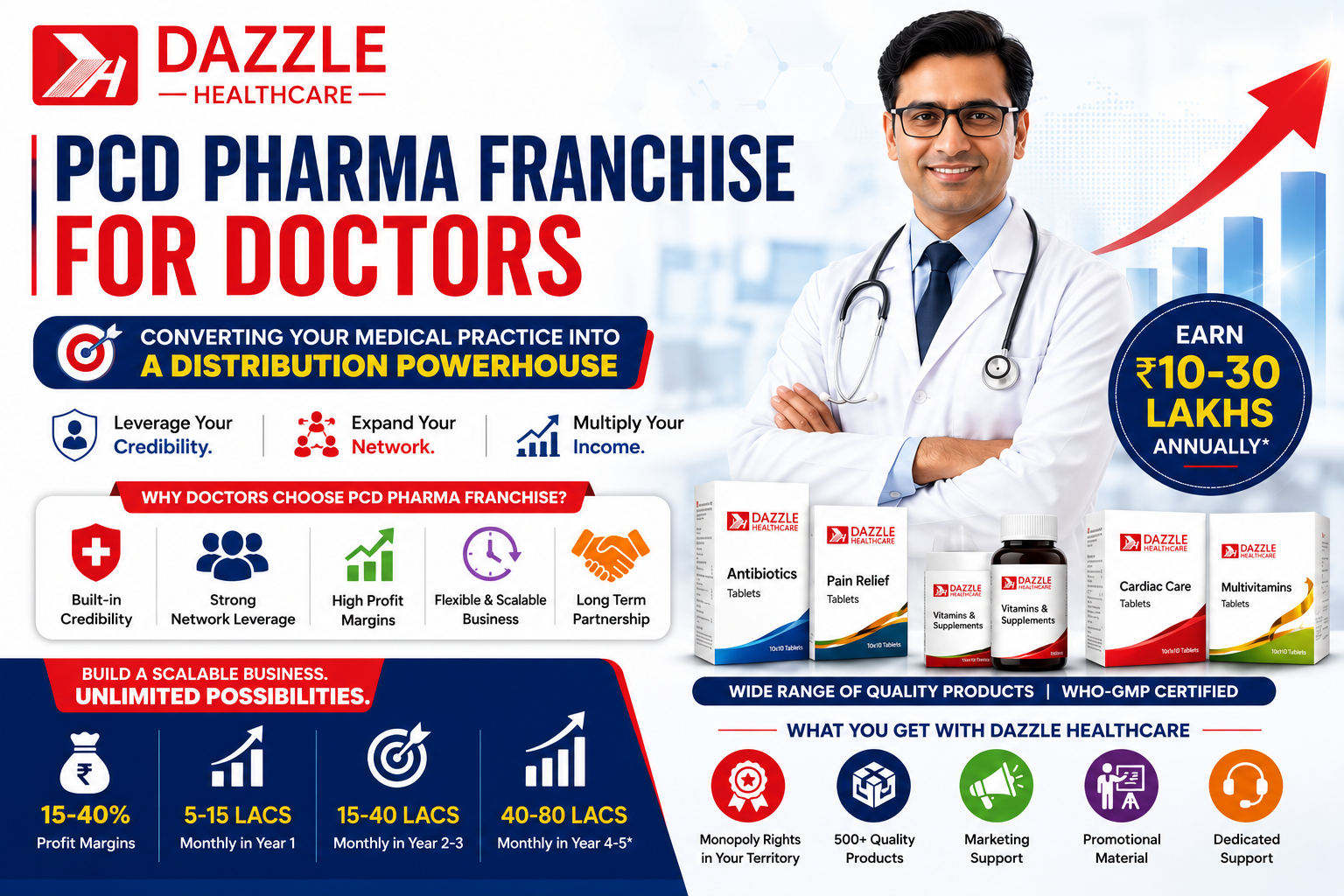
The Untold Reality: Why Thousands of Indian Doctors Are Quietly Building Million-Rupee Distribution Empires
Dr. Rajesh Kumar had patients in his clinic, a decent practice, and steady income. But at 42, he realized something. While he helped people get better, he wasn't leveraging his biggest asset: his credibility and network.
That's when he discovered PCD pharma franchising.
Today, two years later, his distribution business brings in Rs. 25 lakhs monthly—while his clinic operates almost on autopilot. He's not alone. Across Mumbai, Bangalore, Delhi, and Hyderabad, hundreds of doctors are quietly building pharmaceutical distribution empires using a business model specifically designed for them.
This isn't pharmaceutical manufacturing. This isn't becoming a pharma company. It's something far simpler, far more profitable, and far less risky.
It's the PCD pharma franchise model—and doctors are positioned perfectly to dominate it.
But here's what most doctors don't know: converting your practice into a distribution business isn't just about adding another revenue stream. It's about multiplying your income while using the exact same assets that made your practice successful in the first place.
What Is PCD Pharma Franchise? (The Doctor's Version)
PCD stands for Propaganda Cum Distribution—a title that sounds outdated but describes a business model that's becoming increasingly lucrative.
Here's how it works:
A pharmaceutical manufacturer (like Dazzle Healthcare) gives you exclusive rights to market and distribute their products within your territory. You're not manufacturing. You're not handling regulatory approvals. You're simply marketing high-quality medicines to doctors, hospitals, clinics, and pharmacies—audiences you already understand and often already know personally.
The parent company handles:
- Manufacturing and quality control
- Regulatory compliance and certifications (WHO, GMP, ISO)
- Product pricing strategy
- Research and development
You handle:
- Local marketing and promotion
- Building relationships with doctors and chemists
- Managing distribution network
- Generating sales in your territory
For doctors specifically, this is a game-changer because:
You already possess medical credibility. When you walk into a hospital or clinic recommending a product, doctors listen differently than they would to a salesman. You speak their language. You understand their concerns. You know what works.
You have a built-in network. Your patients know you. Other doctors in your city know you. Pharmacists in your area recognize your name. You don't start from zero—you start from a position of trust.
You understand the medical market. You know which medicines are in demand, which conditions are most prevalent in your region, and which products doctors prefer prescribing.
The Doctor's Dilemma: Why Your Current Practice Income Is Capped
Here's a hard truth nobody tells doctors: your practice income has a ceiling.
More patients = More time More cases = More hours
Even if you work 60-hour weeks, your practice income is limited by the finite number of hours you have. A cardiothoracic surgeon earning Rs. 50 lakhs annually isn't going to 3x that income by seeing more patients. The math breaks.
But here's what a doctor can do: build a parallel income stream that doesn't require your direct time once systems are in place.
PCD pharma franchising does exactly that.
An average PCD partner generates 15-40% profit margins. With the right territory and product mix, doctors are seeing:
- Rs. 5-15 lakhs monthly revenue in Year 1
- Rs. 15-40 lakh monthly revenue in Years 2-3
- Rs. 40-80 lakh monthly revenue in Years 4-5 with multi-state expansion
And crucially: once your distribution network is established, it runs increasingly with less of your hands-on time.
Why Doctors Become Elite PCD Franchisees (The Hidden Advantages)
If you search for "PCD pharma franchise," you'll find generic advice. But for doctors, the advantages are exponentially higher. Here's why:
1. The Credibility Multiplier (40% Sales Advantage)
A pharmaceutical salesman says, "This is an excellent antibiotic." A doctor says, "Based on my clinical experience, this antibiotic works exceptionally well for respiratory infections."
Same product. Completely different conversion rate.
Hospitals and large clinics prefer sourcing from medical professionals because it validates quality. This isn't bias—it's business sense. When a doctor-franchisee recommends products, hospitals trust the clinical backing.
This credibility advantage means you can:
- Secure hospital supply contracts faster
- Negotiate better terms (supply agreements instead of one-off orders)
- Establish exclusive supplier relationships
- Command better profit margins
2. The Network Leverage (60% Time Advantage)
Your clinic's patient list is one network. But you have others:
- Medical school batch mates (many now hospital owners, clinic managers, lab directors)
- Colleague doctors in your city
- Pharmacists you refer patients to
- Hospital administrators you've worked with
- Nursing home owners
A typical PCD partner spends months building these relationships. You already have them.
One doctor-franchisee we spoke to converted 15 pharmacy partnerships and 3 hospital supply contracts within the first 2 months—using his existing network. His salesman counterpart would take 6-8 months for the same result.
3. The Clinical Authority (Product Positioning Advantage)
You understand which products solve real clinical problems. Generic PCD partners have product catalogues. Doctors have clinical insight.
This means you can:
- Focus on high-demand therapeutic categories (antibiotics, cardiac, diabetic) where you have credibility
- Position products based on clinical outcomes, not just margins
- Build loyalty with prescribing doctors because recommendations are clinically sound
- Scale into emerging categories (cancer support care, critical care injectables) where your expertise matters
4. The Trust Factor (30-50% Better Customer Retention)
Doctors who source from another doctor develop loyalty. You're not just a salesman; you're a peer.
This translates to:
- Higher repeat order rates
- Better payment compliance
- Willingness to stock wider product ranges from your portfolio
- Referrals to other healthcare providers
The Complete Financial Picture: What You'll Actually Earn
Let's talk real numbers—not the inflated claims you see on franchise websites.
Year 1 Realistic Numbers (Conservative Territory of 500-1000 beds)
Initial Investment:
- Franchise fee: Rs. 2-5 lakhs
- Initial stock: Rs. 3-8 lakhs
- Office/storage setup: Rs. 1-2 lakhs
- Marketing materials: Rs. 50K-1 lakh
- Legal and licensing: Rs. 50K
Total: Rs. 7-17 lakhs
Monthly Operations:
- Sales target: Rs. 15-25 lakhs
- Cost of goods: Rs. 12-20 lakhs (75% of sales)
- Gross profit margin: Rs. 3-5 lakhs (20-25%)
- Operating expenses: Rs. 1-1.5 lakhs (1 staff member, vehicle, communication)
- Net monthly profit: Rs. 1.5-3.5 lakhs
Year 1 Annual: Rs. 18-42 lakhs after investment recovery
Year 2-3 Realistic Numbers (Established Territory, Expanded Network)
- Monthly sales: Rs. 40-60 lakhs
- Gross profit: Rs. 8-15 lakhs
- Operating expenses: Rs. 2-2.5 lakhs (expanded team)
- Net monthly profit: Rs. 6-12.5 lakhs
Annual: Rs. 72-150 lakhs
Year 4-5 (Multi-Territory or Specialized Categories)
- Monthly sales: Rs. 80-150 lakhs
- Gross profit: Rs. 16-37.5 lakhs
- Operating expenses: Rs. 3-4 lakhs
- Net monthly profit: Rs. 13-33.5 lakhs
Annual: Rs. 150-400 lakhs
Reality check: These numbers assume consistent effort, good partner selection, and competent execution. Bad territory selection can halve these numbers. Excellent execution can exceed them.
The Step-by-Step Blueprint: Converting Your Practice to Distribution Power
Phase 1: Assessment & Planning (Month 1)
Step 1: Territory Audit
- Which medicines are your patients buying most?
- Which pharmaceutical companies are already dominant in your area?
- Which categories have supply gaps (where doctors complain about availability)?
- What's the population density, hospital count, and clinic density in your territory?
Step 2: Company Selection Not all PCD companies are equal for doctors. You need:
- WHO-GMP-ISO certification (non-negotiable)
- 400+ products across multiple categories (don't start with 50-product catalogs)
- Proven track record with doctor-partners (not just salesman-partners)
- Reasonable credit terms (60-90 days standard)
- Active marketing support (not just handing you catalogs)
- Realistic margins: 20-25% typically healthy
Step 3: Financial Readiness Ensure you have Rs. 10-20 lakhs available capital that won't be needed for 6 months. This covers initial inventory, setups, and covers the ramp-up period before consistent sales.
Phase 2: Setup & Licensing (Months 1-2)
Required Documents:
- Drug License (DL): State-level, obtained through Drug Controller of the State
- GST registration: Central and state level
- PAN and AADHAR
- Business registration: Proprietorship or private limited company
- Bank account: Separate business account
- Insurance: Product liability insurance for medical products
Timeline: 30-45 days Cost: Rs. 30-50K total
Phase 3: Market Entry Strategy (Months 2-3)
Week 1-2: Personal Outreach Contact 25-30 key stakeholders personally:
- 5-10 pharmacists (close allies in the beginning)
- 5 clinic owners/nursing home administrators
- 5-8 fellow doctors you know
- Hospital procurement officers (direct if possible)
Message: "I've started a pharmaceutical distribution business with [Company Name]. We have excellent products in [Category]. I'd like to supply your pharmacy/clinic."
Personal meetings close 40-60% of these initial contacts.
Week 3-4: Institutional Outreach
- Meet hospital procurement teams (with samples)
- Propose supply agreements (monthly retainer + additional orders)
- Establish small pharmacy partnerships
Month 2-3: Active Networking
- Medical association meetings
- Health camps (sponsor or organize)
- Industry events
Phase 4: Growth & Scaling (Month 4-12)
Months 4-6:
- Establish 20-30 active pharmacy relationships
- Secure 2-3 hospital supply contracts
- Build reputation for reliability and quality
- Monthly sales: Rs. 8-15 lakhs
Months 7-12:
- Expand to complementary product categories
- Add 15-20 more pharmacy relationships
- Possibly secure 1 large institutional buyer
- Monthly sales: Rs. 15-25 lakhs
Phase 5: Systemization & Expansion (Year 2 Onwards)
This is where your expertise as a doctor matters most:
- Hire a capable distribution manager
- Recruit 2-3 medical representatives (they work better under doctor supervision)
- Implement inventory management system
- Expand to adjacent territories (especially if you have doctor networks there)
- Diversify into specialized categories where your clinical knowledge adds value
The Real Challenges (And How Doctors Overcome Them)
Challenge 1: Market Saturation in Some Territories
Reality: In metros and saturated markets, the easy money is gone. There are already 8-15 PCD partners in many urban areas.
Doctor Advantage: You can specialize. Instead of trying to be everything in a saturated market, focus on categories where your credibility matters most:
- Critical care injectables (requires doctor validation)
- Specialty pharmaceuticals (cardiac, diabetic, neuro)
- Institutional supply (hospitals prefer doctor-partners)
Generalist PCD partners struggle here. Specialists prosper.
Challenge 2: Credit Management and Bad Debts
Reality: Pharmacies and small clinics sometimes default on payments. Bad debts kill PCD businesses.
Doctor Advantage: Your credibility allows you to:
- Demand stricter payment terms (COD or 15-30 days instead of 90)
- Better assess creditworthiness of partners (you know the pharmacies)
- Enforce payment through peer pressure (doctor network advantage)
- Build agreements that protect you
Challenge 3: Time Management (Running Clinic + Distribution)
Reality: Can you actually manage both?
Doctor Answer: Yes, but not forever in high-intensity mode.
The Model:
- Year 1: 70% clinic, 30% franchise (hands-on building)
- Year 2: 50% clinic, 50% franchise (active management)
- Year 3+: 30% clinic, 70% franchise OR maintain clinic for credibility, let franchise run on systems
Many successful doctor-franchisees do this:
- Maintain clinic 2-3 days per week (keeps credentials active, provides referrals)
- Dedicate 3-4 days to franchise business
- Use clinic as demonstration ground for products
Why Dazzle Healthcare Is The Right Partner For Doctors
When selecting a PCD company, doctors need different things than typical entrepreneurs:
Dazzle Healthcare offers doctors:
- Doctor-Friendly Terms: 400+ products across all therapeutic categories—giving you the flexibility to specialize in areas matching your expertise
- Credibility Matching: WHO-GMP-ISO certified—the credentials matter when doctors evaluate your supply sources
- Clinical Support, Not Just Sales: Training focused on product efficacy, clinical outcomes, and ethical promotion—not just pushing units
- Network Advantages: Connected with doctor-partners across pan-India—built-in learning community and referral system
- Reasonable Margins: 20-25% industry-standard margins with transparent pricing
- Institutional Relationships: Already established in hospital and nursing home channels—you inherit some of this credibility
The Decision Framework: Should You Start a PCD Franchise?
You should consider a PCD franchise if:
- Your practice is stable (not in survival mode)
- You have Rs. 10-20 lakhs investable capital
- You want additional income without adding patient hours
- Your clinic network is reasonably strong in your city
- You're comfortable with business operations beyond clinical work
- You're in a territory with 100+ bed hospitals or dense clinic concentration
You should NOT start a PCD franchise if:
- Your practice is struggling (focus on that first)
- You're unwilling to invest time in business development for 12 months
- You're in a very small town with minimal healthcare infrastructure
- You expect passive income from month 1 (it requires active building)
- Your reputation matters and you want to stay purely clinical
The Next Step: Converting Your Medical Credibility Into Measurable Revenue
Many doctors leave Rs. 1-5 crores on the table by not exploring pharmaceutical distribution. They think:
- "I'm not a salesman"
- "It's beneath my qualification"
- "I'm too busy"
But the doctors actually doing this realize something crucial: PCD franchising isn't beneath medical qualification. It's an application of medical credibility in a business context.
You don't need to become a salesman. You need to leverage what you already are: a trusted medical professional with a network and credibility.
If you're seriously considering this:
- Audit your territory: What medicines are in demand? What supply gaps exist? (2-3 weeks)
- Research 3-4 companies: Meet their representatives, understand their model, and check doctor-partner references (2-4 weeks)
- Financial planning: Ensure you have capital, understand tax implications, plan your time allocation (1 week)
- Trial period: Start with one product category with 1 company. Test the model with minimal investment. (3 months)
- Scale: If the trial works, expand into multiple categories or territories.
The doctors earning Rs. 20-100 lakhs monthly from pharma distribution didn't start with a master plan. They started with a decision to leverage what they already had.
Quick FAQ for Doctor-Franchisees
Q: Can I run a PCD franchise while maintaining my clinic practice? A: Yes. Year 1 is intensive. By Year 2-3, it runs on systems. Many doctors split time 50-50 or maintain clinic for credibility.
Q: What if I don't have medical licensing in the distribution area? A: You don't need a medical license to distribute. You need business licenses and drug licenses (which anyone can obtain).
Q: How much time does it really take? A: Year 1: 10-15 hours/week beyond clinic time. Year 2-3: 15-25 hours/week. Year 4+: 10-15 hours/week (systems management).
Q: Can I do this alongside my hospital job? A: Risky but possible if you have strong management. Many successful franchisees are still hospital consultants (0-2 days/week).
Q: What happens if I want to exit after 2-3 years? A: Most franchise agreements have exit clauses (3-6 months notice). You can sell the business to another qualified doctor.
The Reality Nobody Talks About: Your Competitive Advantage as a Doctor Is Finite
Here's something crucial: the longer you wait, the more saturated your market becomes.
In 2020, finding untapped PCD opportunities in tier-1 and tier-2 cities was easy. In 2024, it's harder but still possible. By 2027-2028, many good territories will be claimed.
If you're considering this, the optimal time isn't "eventually"—it's now.
The doctors who started in 2020-2021 are now earning 5-10x more than doctors entering saturated markets in 2025.
Your Action Step Today
Not tomorrow. Today.
If you're genuinely interested in converting your medical practice into a distribution powerhouse:
Text or WhatsApp: +91-9371300000
Mention: "I'm a doctor interested in a PCD pharma franchise—specifically for [your specialty/location]"
Dazzle Healthcare has doctor-specific franchise programs. They understand your constraints, your network leverage, and your need for clinical credibility.
A brief conversation could change the trajectory of your business life.
Because here's the truth: medicine made you credible. But credibility, properly leveraged, can make you wealthy.
#PCDFranchise #DoctorEntrepreneur #PharmaFranchise #MedicalBusiness #HealthcareDistribution

